Looking for help in identifying scholarship opportunities? Get expert guidance today.
The Commonwealth Shared Scholarship is one of the scholarship opportunities available to students from eligible Commonwealth countries who wish to pursue a fully funded master’s degree in the United Kingdom.
Unlike some scholarship programmes, the Commonwealth Shared Scholarship is offered through selected UK universities and approved master’s programmes. Applicants must apply for admission to an eligible course and submit a separate scholarship application through the Commonwealth Scholarship Commission’s online application system.
If you are interested in applying for the 2027/2028 academic year, the scholarship application is scheduled to open on 10 November 2026 and close on 8 December 2026 at 16:00 GMT.
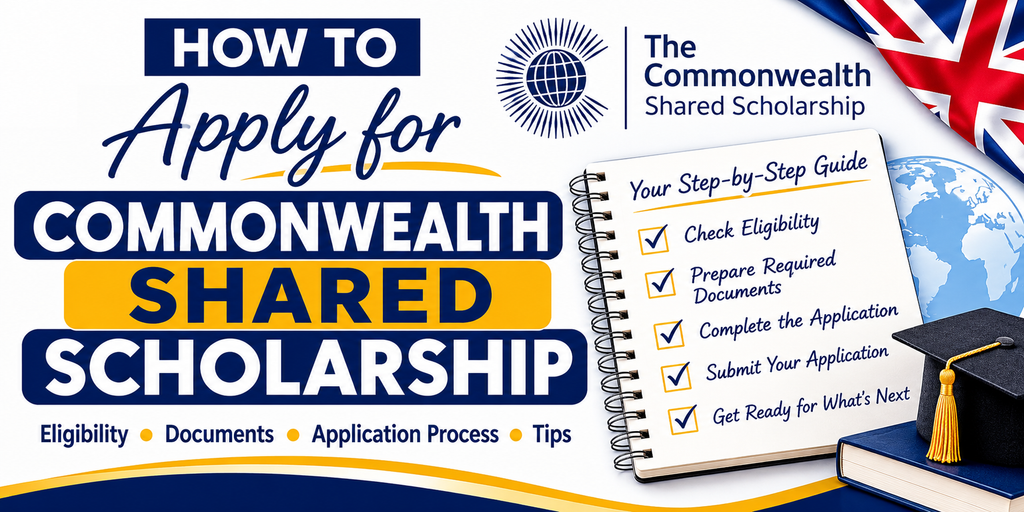
Below is a step-by-step guide on how you can approach the application process:
Looking for help in identifying scholarship opportunities? Get expert guidance today.
1. Identify Eligible Universities and Master’s Programmes
The first and most important step is to identify the universities and eligible master’s programmes approved under the Commonwealth Shared Scholarship for the 2027/2028 academic year.
To get started:
- Click the attached link to identify the eligible courses available for the 2027/2028 academic year: https://cscuk.fcdo.gov.uk/commonwealth-shared-scholarships-eligible-courses/
- Visit the respective university websites to understand the admission requirements for your preferred programmes.
- Prepare the required documents which may include academic transcripts, a CV, references and a personal statement.
- Submit your application for admission according to the university’s instructions.
You can apply to more than one university and course but you should ensure that each programme is approved under the Commonwealth Shared Scholarship.
2. Prepare for the Commonwealth Shared Scholarship Application
Once you have identified your preferred courses and checked the university admission requirements, the next step is to prepare your scholarship application.
The Commonwealth Shared Scholarship application for the 2027/2028 academic year is scheduled to open on 10 November 2026 and close on 8 December 2026 at 16:00 GMT.
Applications are submitted through the Commonwealth Scholarship Commission’s online application system, known as CSC Central.
This scholarship has a number of essays attached to it and below is a breakdown on how you can approach them;
1. Development Impact Essay
The Development Impact statement is one of the most important sections of your Commonwealth Shared Scholarship application. It gives you an opportunity to demonstrate how your proposed master’s programme will help you address a development challenge in your home country.
The essay is divided into four parts, and each part requires you to address a different aspect of the development impact you intend to create.
Part One: How does your proposed study relate to development issues at the global, national and local levels and the wider sector?
In this section, you are expected to explain the development challenge you intend to address and how it relates to the wider development priorities of your country and the world.
When answering this question, use the following approach:
· Global problem: Introduce the development issue using a global statistic and explain its wider consequences.
· National problem: Present a country-specific statistic showing the extent of the issue in your home country.
· Local impact: Explain how the problem affects local communities or specific groups of people.
· CSC development theme: Connect the problem to your selected development theme and explain why addressing it is important to the wider sector.
· Proposed studies: Explain how the master’s programme will equip you with the knowledge and skills needed to address the problem.
Avoid simply describing a development problem without showing why it matters or how your proposed studies will help you address it.
Part Two: How will you apply your new skills once your scholarship ends?
This question focuses on what you intend to do after completing your master’s degree. The selection panel wants to understand how you will use the knowledge and skills gained from your studies to contribute to development in your home country.
How to approach this section;
- Start with your relevant modules; Identify specific modules from your chosen programme and explain the knowledge or skills you expect to gain from them and how they will help you solve the mentioned development challenge.
- Explain the practical activities you intend to undertake: Show how you will use the knowledge gained to introduce projects, initiatives, policies or interventions that address the development challenge you identified.
- Identify the institutions or communities where you will apply your skills: Mention the organizations, departments or local communities where you intend to use your newly acquired knowledge.
Important: Avoid simply listing modules or stating that you intend to use the knowledge gained to improve your sector. Explain how the specific skills acquired will translate into practical actions when you return home.
Part Three: What do you expect will change in development terms after completing your studies?
This question requires you to explain the specific changes you intend to achieve after completing your master’s degree.
You should go beyond stating that you want to contribute to national development. Instead, identify the outcomes you hope to achieve, when you intend to achieve them and who will benefit from your work.
When answering this question, consider the following:
1. Previous achievements: Briefly highlight relevant work you have already done to demonstrate your ability to achieve the proposed outcomes.
2. State your career goals: Break them down into short-term, mid-term and long-term goals. For each stage, explain the activities you intend to undertake and the development impact you hope to achieve, using measurable targets and figures where possible.
Part Four: How can the impact of your work best be measured and evidenced?
In this section, you need to explain how you will demonstrate that your proposed interventions have achieved the expected results.
Think about the indicators you will use to measure progress and the evidence you will collect to demonstrate the impact of your work.
For example, if your goal is to improve healthcare delivery across 20 health facilities, you could measure progress through the number of facilities adopting the new systems, improvements in service delivery and reductions in patient waiting times.
Your response should demonstrate that you understand how to monitor and evaluate the results of your proposed interventions.
In my Development Impact video, I use practical step-by-step guidelines on how to structure each section of the Development Impact essay so as to align it with the Commonwealth Scholarship requirements.
Click here to watch the video and get a free essay review
2. Career Plan Essays
The Commonwealth Shared Scholarship application also requires you to explain your career plans after completing your master’s degree. You will need to discuss both your plans for the five years following the scholarship and your long-term career goals.
Part 1: Career Plans for the First Five Years After the Scholarship
For this question, explain the professional roles you intend to pursue after completing your master’s degree and how you will use the knowledge gained to contribute to development in your home country.
Your response should identify:
- The organizations or institutions you intend to work with.
- The positions or responsibilities you hope to take on.
- The specific activities or projects you intend to implement.
Avoid presenting career goals that are not connected to your proposed studies or the development challenge you have identified.
Part 2: Long-Term Career Plans
Your long-term career plans should demonstrate how you intend to grow professionally and increase your contribution to development over time.
You can discuss the senior positions you hope to hold, the institutions you intend to work with and the wider development initiatives you hope to influence.
In my Career Plan essay video, I take you through how to develop realistic career goals and demonstrate the contribution you intend to make to your home country.
Click here to watch the career plan essay video and get a free essay review.
3. Proposed Study Essays
The proposed study essay gives you an opportunity to explain what you intend to learn during your master’s programme and how the course will prepare you to achieve your career and development objectives.
When answering this question, consider the following:
- Introduce the subject area: Briefly explain the wider issue or development challenge your proposed study will focus on.
- Identify your research focus: Explain what you intend to investigate or find out through your proposed research.
- Connect your research to your course: Mention how your chosen master’s programme or relevant modules will equip you with the knowledge to undertake the research.
- Explain the purpose of the research: Show what you hope your research will achieve and how it could help address the identified problem.
In my Proposed Study essay video, I provide step-by-step guidance on how to connect your study goals to the development challenges you intend to address in your home country.
Click here to watch the proposed study essay video and get a free essay review.
4. Personal Statement
The personal statement gives you an opportunity to explain how your personal experience in solving challenges has influenced your desire to contribute to development in your home country.
The best approach to every personal statement is the S.T.A.R Technique that clearly brings out your impact
- Situation: Identify a specific problem or challenge you encountered in your workplace, community or personal life.
- Task: Explain the responsibility you had or the role you played in addressing the challenge.
- Action: Describe the specific steps you took to address the problem. Emphasise your personal contribution, leadership and problem-solving skills.
- Result: Explain the outcome of your actions and the impact you made. Use figures and measurable achievements where possible.
To support you with writing a personal statement essay that is well-structured and aligned to the scholarship requirements, click here and get more details on the personal statement service package.
5. Voluntary Activities and Leadership Experience Essay
In this section, you are required to summarise your involvement in voluntary activities and the opportunities you have had to demonstrate leadership.
You should provide practical examples of how you have contributed to your community, supported development initiatives, taken responsibility or influenced positive change.
When discussing your leadership experience, avoid simply stating that you have been a team leader, project coordinator or supervisor. Explain the activities you led, the challenges you addressed and the results achieved and the best way to present all this is through the S.T.A.R Technique.
For example, you could discuss how you coordinated a community health initiative, mobilised young people to participate in an environmental project or led a team to improve service delivery within your organisation.
To support you with writing a voluntary and leadership essay, click here and get more details on the personal statement service package.
Important: Ensure that all the information provided in your application is accurate and that you follow the Commonwealth Shared Scholarship requirements carefully. Review your essays and supporting documents before submission to avoid missing any important details.
Looking for help in identifying scholarship opportunities? Get expert guidance today.